How to build a horse arena in the UK, step by step
If you want to build a horse arena in the UK that rides well all winter, the order of work matters more than the surface you pick. This guide walks through building a ménage the way a groundworks contractor does it: survey, levels, dig, drainage, membrane, stone, surface, fencing and aftercare.
- 1 to 2 weekstypical build on site (Checkatrade, 2026)
- 800 m²in a standard 20x40 m arena
- £10minsurance through First Point
Choose the site and check planning
Pick the flattest, driest piece of ground you have, with room for the arena plus a metre or two all round for fencing and drains. Check lorry access: stone and sand arrive on 20 tonne wagons, and a site they cannot reach costs more to build. Keep it away from trees, whose roots lift a base and whose leaves clog a surface.
Then planning. Most ménages need consent because they are an engineering operation and often a change of use from agricultural land. Read our guide to planning permission for a horse arena before you order anything.
Then timing. Build when the ground is dry, late spring to early autumn. Wet ground, rutting lorries and greasy clay all make a worse job. Use the winter for the site visit, levels and planning, so you are ready to dig the moment the ground firms up.
Survey, levels and the drainage plan
Every good build starts with levels. A survey across the site shows how much fall there is and where. From that you decide the finished level of the arena, the cut and fill needed, and the fall the surface will carry so water runs off rather than sitting.
At the same time, find the outfall. Where will the water go? A ditch, a dyke, a soakaway or a land drain. On flat Fen ground this is the hardest question on the job and the one most often skipped. No outfall, no drainage. Our horse arena drainage guide covers the options.
Strip the topsoil and cut the formation
Topsoil comes off first. It is soft, organic and holds water, so it never stays under an arena. Keep it on site for banks and landscaping, or cart it away.
Then the formation is cut: the firm subsoil the whole arena sits on. It is trimmed to a single plane with the planned fall and rolled. On a slope, the high side is cut and the low side filled in compacted layers. On soft ground, soft spots are dug out and replaced with stone. A formation that is uneven or soft is the root of almost every arena that goes wrong.
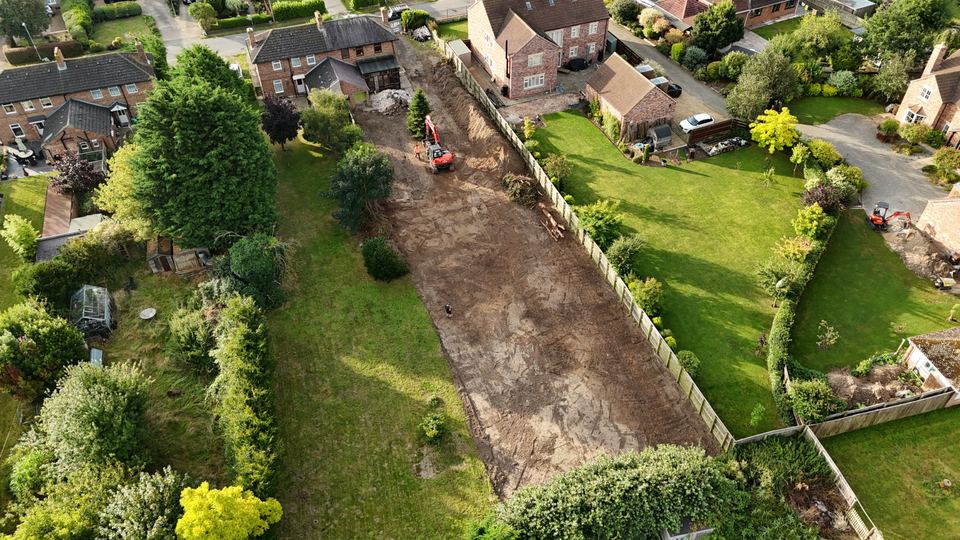
This is our everyday work. At Walpole St Peter we took 600 tonnes of soil off site in a week. On site clearance jobs around Spalding we strip and level whole plots from the air down.
Install the drainage
On most UK soils, and on all Fen clay, building a menage means a herringbone system: perforated lateral drains in narrow trenches, angled into a central or side carrier pipe that runs to the outfall. The trenches are backfilled with clean stone so water drops straight into the pipes.
On genuinely free-draining sand a perimeter drain round the edge does the job. Either way, the pipes go in before the stone base, laid to fall and checked, because nobody digs them up again once the arena is finished.
Membrane and stone base
A geotextile membrane goes on the formation. It stops the subsoil pumping up into the stone when horses work on it, the most common cause of a base turning to mud.
Then the stone. Clean, angular stone is laid in layers, each one rolled, to the depth your ground needs: deeper on soft ground, shallower on firm. The top is blinded with finer stone and rolled again to a tight, true finish that follows the planned fall exactly. Check it with a laser level. Any dip in the base becomes a deep spot in the surface.
Surface, fencing and aftercare
Surface. A separation membrane goes over the stone to keep the surface clean, then the surface is spread to an even depth: silica sand, sand and fibre, sand and rubber or waxed. Compare them on horse arena surfaces.
Fencing. Post and rail with kickboards keeps horses in and surface on the arena. Put a gate in wide enough for a tractor and harrow.
Aftercare. Harrow or level the surface regularly so it stays even, pick up droppings, water sand in dry spells, and keep the drains and outfall clear. When it wears, arena resurfacing brings it back.
DIY horse arena or a contractor?
Outdoor riding arena plans look simple on paper. The hard parts are the ones you cannot see: levels set to millimetres over 800 m² or more, drainage laid to fall, a formation and stone base compacted properly. They need laser levels, excavators, dumpers, rollers and operators who use them every day.
A DIY horse arena that skips those steps rides well for a summer and fails in the first wet winter. If you want it built once, we build it for you: see horse ménage construction. A full installation takes one to two weeks on site and a 40x20 m arena typically costs £20,000 to £40,000 (Checkatrade, 2026).
Plant and kit for building a ménage
Laser level
Sets the formation, base and surface to one true plane and fall.
Tracked excavator
Strips topsoil, cuts the formation and digs the drain trenches.
Dumpers
Move spoil, stone and surface around site without rutting the ground.
Roller
Compacts the formation and every layer of stone.
Lorries
Deliver stone and surface in 20 tonne loads and take spoil away.
Ticketed operators
Every HB plant operator holds the relevant tickets.
Jobs that prove it
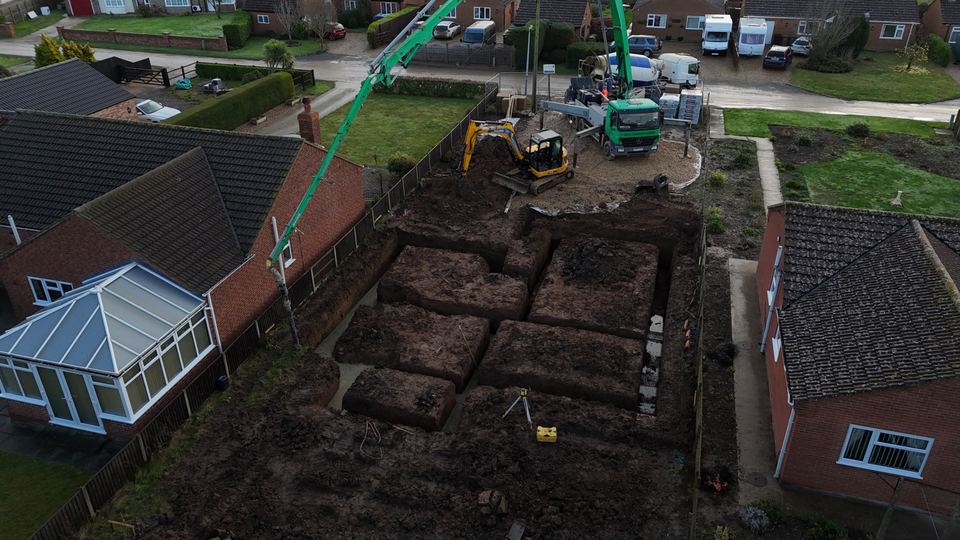
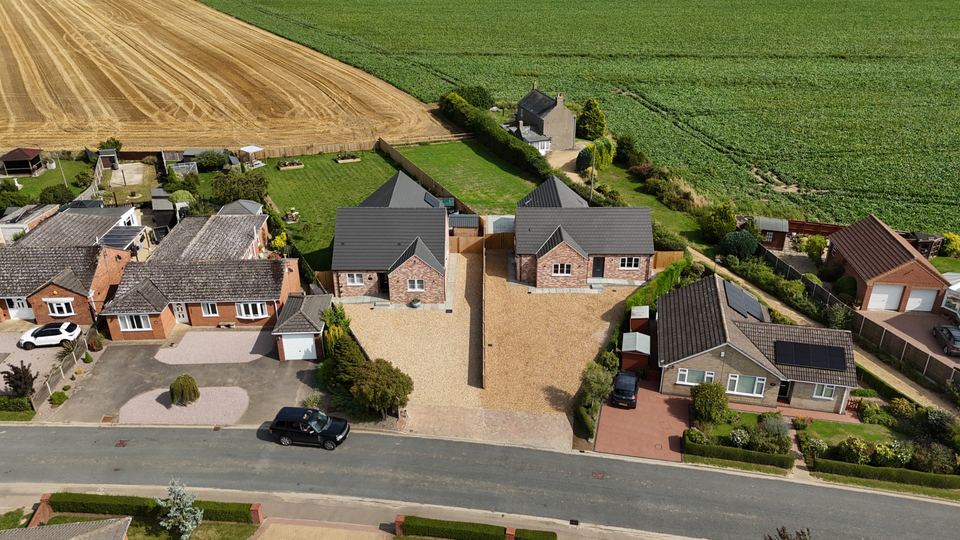
Real jobs, named places, our own photos.
What customers say about Haydn and the team
“Just OUTSTANDING from start to finish, nothing was too much trouble and communication was fantastic throughout the process would absolutely recommend him.”
“Competitive rates,would highly recommend. I’ve had many jobs done, all been completed to 100% satisfaction.”
“Excellent service fast and efficient 💪”
Ménage questions, answered
Anything else, ring Haydn on 01945 669203.
How long does it take to build a ménage?
A typical installation takes one to two weeks on site (Checkatrade, 2026). Planning, if needed, comes before that.
What goes under a ménage surface?
From the bottom up: a levelled and rolled formation, a geotextile membrane, drainage, a compacted stone base blinded to a true finish, a separation membrane, then the surface.
Can I build a horse arena on a slope?
Yes. The high side is cut and the low side filled and compacted in layers to make one level plane with a gentle fall for drainage. Steeper slopes mean more earth to move, which adds cost.
Can I ride on a new ménage straight away?
Yes, once the surface is down and levelled. Ride it lightly for the first few weeks and harrow it often while the surface beds in and settles to an even depth.
Is a membrane under the stone really needed?
Yes, on almost every site. Without it, subsoil works up into the stone under the weight of horses and the base turns soft. It is cheap to lay and impossible to add later.
What is the most common mistake when building a menage?
Skimping on what you cannot see: no membrane under the stone, no fall on the formation, or drains with nowhere to discharge. All three show up in the first wet winter.
Do you build ménages from start to finish?
Yes. We carry out every step in this guide with our own plant and ticketed operators. Call Haydn on 01945 669203 to book a free site visit.
Book a free site visit
Tell us about the job. Haydn comes out, looks at the ground and the access, and gives you a price.